A garage, a sharpening shop, a gallery
Most of the buildings on this stretch of Edgewood Avenue date from Sweet Auburn's early-twentieth-century building boom — brick storefronts put up in the 1910s and 1920s, as Black-owned businesses relocated here from downtown Atlanta. This one is younger. It started as a concrete-block garage in 1946, at the tail end of that wave, and spent the next sixty years as a working tool shop before anyone thought to call it historic.
1946 — A garage on Edgewood Avenue
On February 25, 1946, A.C. White pulled a permit for a one-story, 30-by-60-foot concrete block garage at 395 Edgewood. White was a moving-and-storage man, not a builder — his firm, A.C. White Transfer & Storage, was based nearby at 410 Edgewood Avenue, and it's possible he used this lot for parking and truck storage for that business. The builder of record was L.E. Winters. No architect is named on the permit; this was a utility building, not a design statement.
That plainness is part of the story. Most of what survives nearby from Sweet Auburn's commercial strip is more ornamented than this building ever was — storefronts with display windows, cornices, some Italianate detail. This one was never that. It was built to hold vehicles and tools, and everything that happened to it afterward is the record of someone actually using it.
1947–2011 — The Keen-Edge Company
Keen-Edge, a tool sharpening, repair, and sales business, shows up in the city directory at 395 Edgewood in 1947, one year after the garage went up. Its original owner was Chester E. Perkins Sr.; his son, Chester E. Perkins Jr., owned the property when it was sold in 2006. Keen-Edge occupied the building for roughly six decades in total.
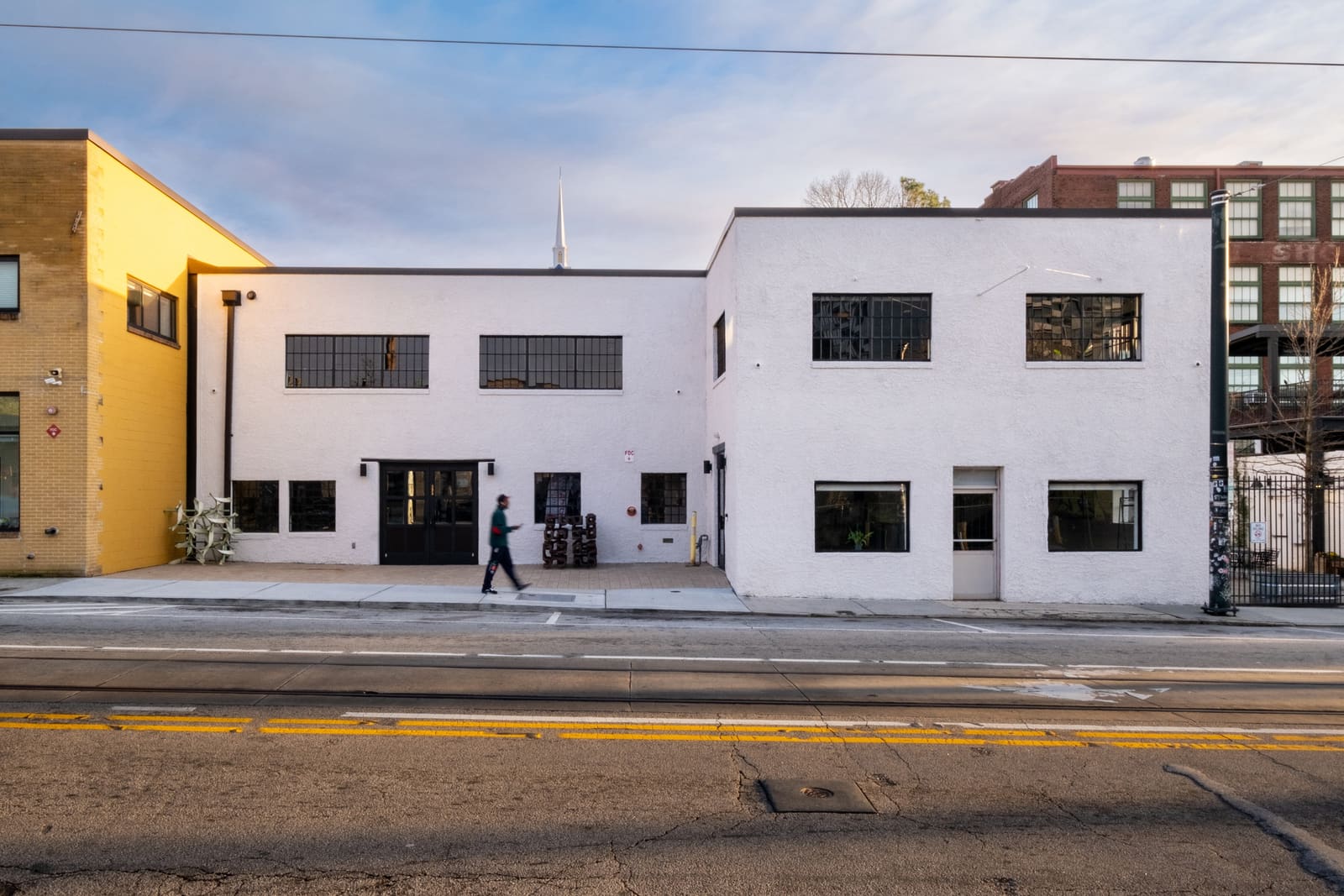
A permit filed in November 1960 under Chester E. Perkins's name added a full second story to the building, completed by February 1962 — doubling its floor area and giving it the profile it has today.
The Keen-Edge sign that greets visitors today is the original, restored rather than reproduced. Per the client, it no longer hangs on the facade — it's been brought inside — but it's the same sign that marked this as a tool shop for decades, not a replica made to look old.
2006–2014 — Sold, vacated, purchased
Chester Perkins Jr. sold the property in 2006. Keen-Edge kept operating for a few more years before relocating to Tucker, Georgia by around 2011, and the building sat vacant after that.
Marjan Yavari, through Navmar LLC, purchased the property around 2014.
2016 — "Education Is Not a Crime"
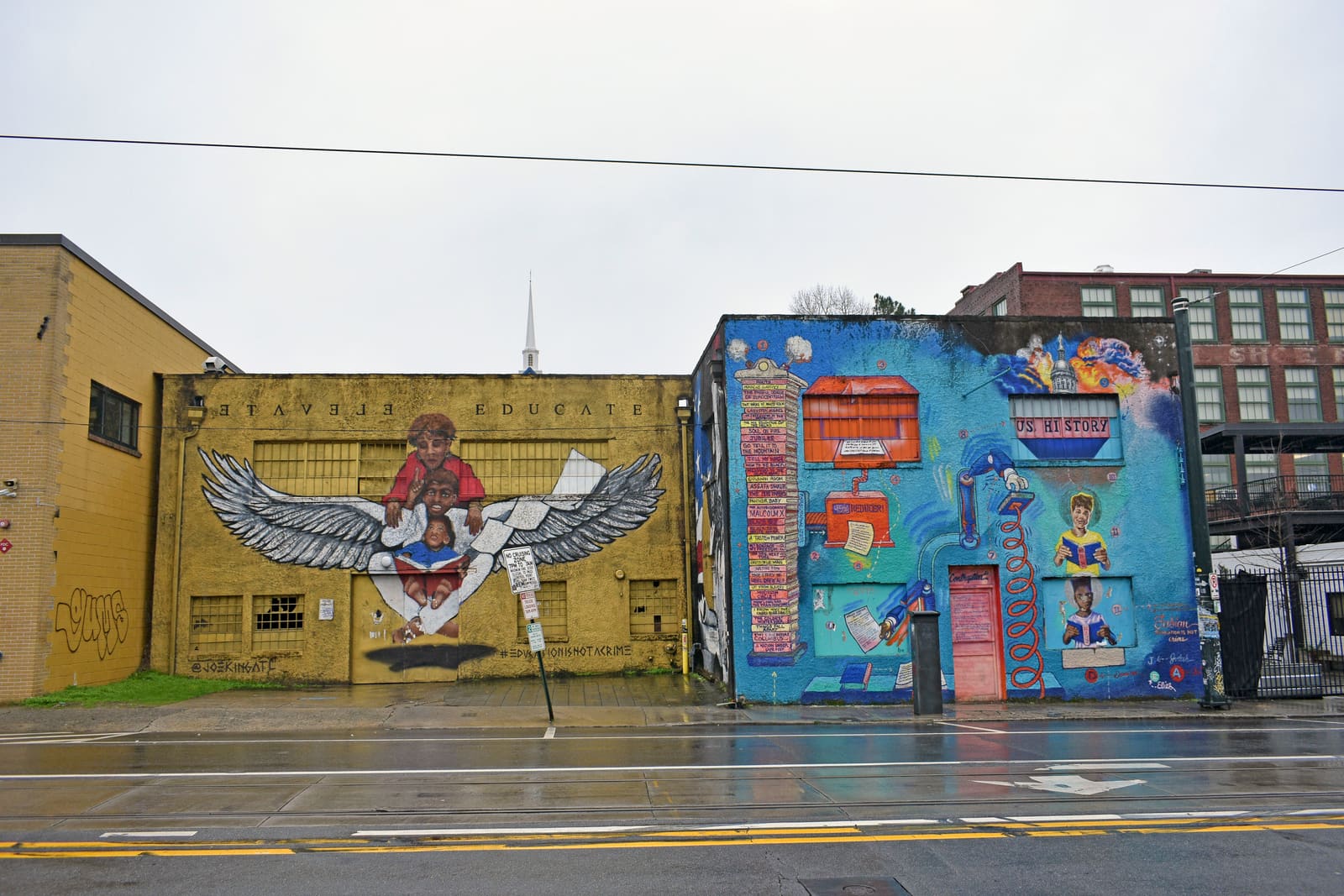
Before any construction began, the building's exterior became a canvas. In April 2016, three murals went up here in a single week, part of "Education Is Not a Crime" — Maziar Bahari's international campaign against Iran's exclusion of Bahá'ís from higher education. Three artists painted them: Fabian Williams, Charmaine Minniefield, and Joe "King ATL" Dreher.
Dreher's wall (@JOEKINGATL) carries winged children holding books, tagged #EducationIsNotACrime; Williams' wall, lettered "U.S. Hi Story," is hisParagraphalizer — a machine, from his Contraption series, compressing 400 years of African American history into a single textbook paragraph. Both are visible in the 2019 photograph above, on this building's front elevation. Minniefield's mural was built from a 1969 photograph by Dr. Doris Derby of residents of Mound Bayou, Mississippi.
Williams was later the lead plaintiff in Williams v. City of Atlanta (2017), the consent order that ended the city's permit requirement for murals on private property — a case that followed these murals by a year, and didn't produce them, but changed the rules for everything painted on private walls in Atlanta afterward.
The building had no formal use at the time — it had been vacant since around 2011. The murals gave the walls a public presence anyway, in a stretch that would otherwise have sat blank for years.
2023–2025 — Renovation
Groundbreaking on the redevelopment was July 11, 2023, with Smith Dalia as architect. The project, completed in 2025, kept the building's footprint and the Keen-Edge sign while converting the interior for its current use: event space, gallery, and offices anchored by the National Center for Race Amity.
The building is privately owned. Yavari is Bahá'í; the building is not a Bahá'í institution, and is not connected to the Bahá'í Center at 379 Edgewood.
2026 — "It Takes A Village"
The mural tradition continued past the renovation. In 2026, artist Drew Borders (@drewborders.art) painted "It Takes A Village" on the building, commissioned with the Historic District Development Corporation (HDDC) — the organization Coretta Scott King, Christine King Farris, and John Cox founded in 1980 to revitalize the district, and which today commissions much of Auburn Avenue's public art. The artist has described the mural's interwoven hands as representing unity and freedom from prejudice — themes that echo the 2016 mural's argument for the right to learn, thirty years and a different artist apart.
Footnote: the 1941 mix-up
Older sources, including earlier drafts of this site, dated the building to 1941. That figure comes from a different business entirely: newspaper ads show the Downtown Chevrolet Company running a "branch lot" on this same parcel in 1941, five years before this building existed.
Sources
Most of the building history above comes from 395 Edgewood Avenue: Historic Structure Report (Ray, Ellis & LaBrie, 2019), commissioned ahead of the renovation, which cites the original February 25, 1946 building permit and Atlanta city directory listings — Keen-Edge Company first appears in the 1947 directory. The ~2014 purchase date is stated by the current owner (Marjan Yavari, via Navmar LLC), not drawn from the HSR or a public deed record. The 2016 mural artists, titles, and the 2017 lawsuit are drawn from a dedicated research pass on Sweet Auburn public art, sourcing streetartmap.org and Georgia Lawyers for the Arts (glarts.org) — material outside the HSR's scope as an architectural and ownership record. Facts about the 2023–2025 renovation, the 2026 mural, and the building's affiliation are sourced directly to the client.